Why should indie developers care about SEO?

TLDR: Should game developers focus a lot of their time on SEO? No. Your time is limited. Stay focused and on task.
- 1: Complete the game by focusing on game development.
- 2: Make the game look fun.
- 2: Make the game be fun.
- 4: Sell the fun!
The world of SEO is the world of content farming search engine bots. As a game developer you don't need to lower yourself to that. You have something more powerful: a game that people actually want to play.
It's called word of mouth. Your game needs to be able to market itself. If it isn't, then you have to ask yourself why you're making it in the first place. No amount of keyword stuffing is going to save a game nobody wants.
That said — and this is where indie game developer SEO gets interesting — there are a few basic technical things you absolutely should do. Not because Google will rain clicks on your Steam page overnight, but because getting these wrong is leaving free money on the table. Happy New Year if you're reading this in January, by the way.
As part of my plans going forward I've been doing some SEO basics in preparation for my upcoming games. Oh, the irony is not lost on me. It's a new year and a new Taeja, hear me out.
Getting visibility before your game releases matters. This is what people call "Marketing." At this point it's basically a glorified word, and the most straightforward version of it is posting to 2-3 large subreddits on Reddit every week and driving traffic to a page you control. Not to Steam. Not to itch.io. To your own website.
I've been making websites long enough to know that driving traffic to someone else's platform is just free advertising for that platform. Steam takes their cut. Reddit owns the thread. The one asset you actually control is your own domain. That's why I opted for the self-hosted website route for absolutelyskint.com, and that decision comes with a short list of things you need to get right.
Indie Game Developer SEO Starts With Page Speed
Make sure your page loads fast on mobile. That's it. That's the whole section.
Okay, not quite. The reason this matters for indie game developer SEO specifically is that most of the people clicking your Reddit posts, your tweets, your Discord links, are on their phones. They see a thumbnail that looks interesting, they tap, and if your site takes four seconds to load they're gone. Google's PageSpeed Insights tool will give you a score out of 100. Anything under 70 on mobile is a problem. We're currently sitting pretty, Google has given me the thumbs up.
The fixes are usually obvious once you run the test: images that aren't compressed, render-blocking JavaScript, fonts loading from five different places. None of this requires you to be a backend developer. It just requires you to actually run the test and not ignore it.
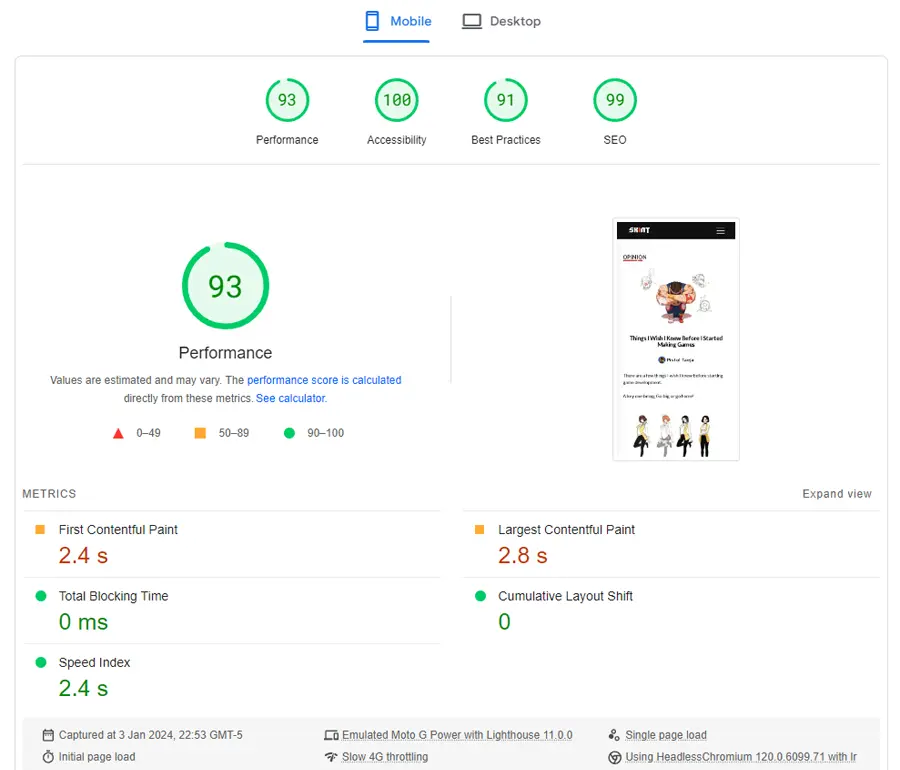
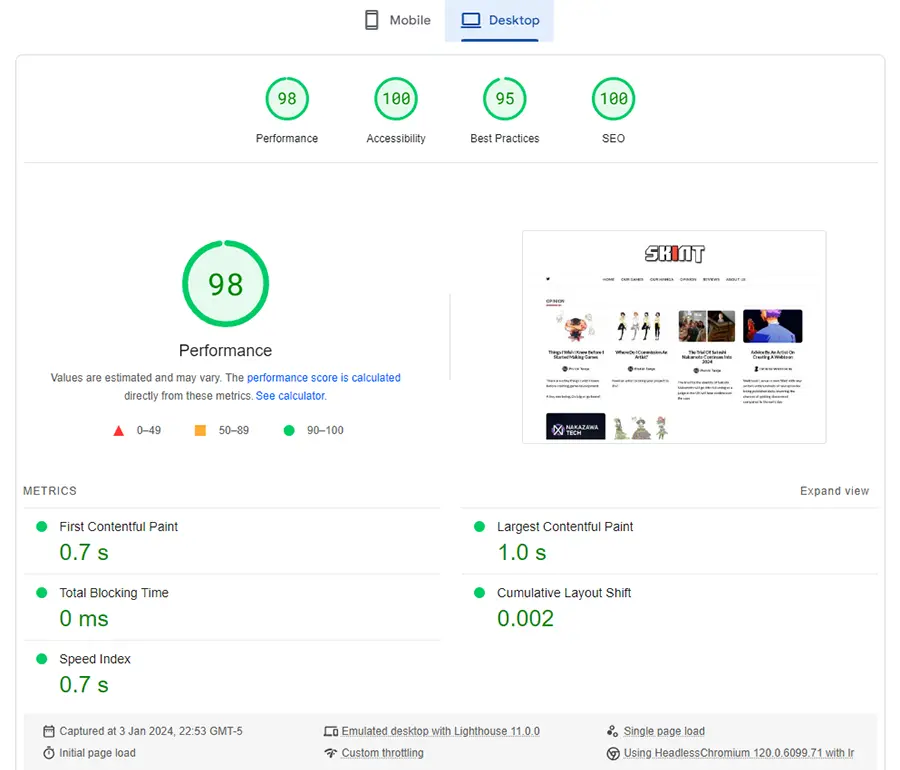
Image Indexing Is Free Real Estate
This one isn't directly related to game development but it's worth doing if you're making original art.
Google Image Search exists and people use it. When someone searches for "pixel art platformer" or "visual novel characters" and one of your concept sketches comes up, that's a discovery moment you didn't have to pay for. The catch is Google needs to know who made the image. After a lot of pushback from big publishers about misattribution, Google now lets website owners properly credit their images.
Since most of the art on this site is mine or made by collaborators I've commissioned, getting ahead of this was easy. Add the right metadata, make sure the alt text is descriptive, point the image back to your author page. Done.
Have you ever done an image search, clicked the result, and instead of the image you got a stock photo website you didn't want? That's what bad attribution looks like. Don't be that.
Author Pages Tell Google Who You Are
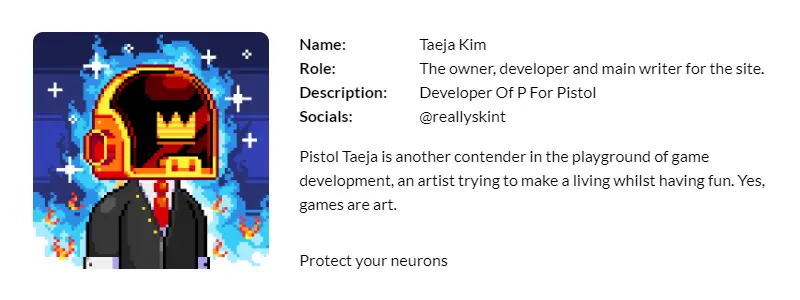
To correctly attribute images, Google needs somewhere to send people. An author page solves this. It also does something more important for long-term indie game developer SEO: it gives you an identity in Google's index.
Google's E-E-A-T framework (Experience, Expertise, Authoritativeness, Trust) is how it decides whether your content is worth ranking. A developer with no author page, no bio, no links to their actual work looks like a nobody. That's not me being harsh, that's just how the algorithm reads it. An author page with a real photo, links to your games, links to your socials, and a few posts under your name starts to build something real.
I've made author profiles for anyone who's helped me this year. They can point to their own Ko-fi, Twitter, or wherever they want to be found. It costs nothing and it's the right thing to do anyway.
What About Content? Do You Need a Blog?
Short answer: only if you'd write it anyway.
The long answer is that a dev blog with actual substance, real updates, real opinions, does help. Not because Google loves blogs but because it gives people a reason to come back to your site before the game is out. A page that never changes has no reason for anyone to revisit it. A dev log that updates every couple of weeks builds a small audience who'll be first in line when you announce a release date.
The catch is that writing purely for SEO, chasing keywords, padding word counts, publishing hollow "top 10 tips" posts you found on a content farm, actively hurts you. Google is better at spotting filler than it used to be. Your readers are better at spotting it too. I wrote about this more directly in the piece on building a creative project from scratch, where the same rule applies: finish the thing, make it real, don't pad.
Your Marketing Strategy After the Game Ships
Normally I'd follow my own advice here and just focus on the game. This year I'm doing something different: building up a presence and an identity before the game is even finished.
I've already built prototypes and demos for P For Pistol. With input from other creators I've been able to nail down what it actually is. At this point the game sells itself on a single image. The right image, framed right, consistently gets clicks across every platform I post it on. The question is whether that interest holds as I go from concept to a finished, shippable game.
The SEO basics, the page speed, the image attribution, the author page, those are the foundation. But the thing that actually moves the needle is having a product people want to share. If you've got that, SEO is just housekeeping. If you don't have that, no amount of keyword research will fix it.
For a parallel take on building something original from nothing, the same logic applies to writing your first manga — the craft and the marketing are two completely separate problems, and you have to solve craft first.
Conclusion
Do the three technical basics. Skip the content farm rabbit hole. Make the game.
If you want to see how I'm applying all of this in practice, follow along with P For Pistol as it actually gets made.